Powered By Blogger

Wednesday, 18 May 2016

Remembering Tagore: Celebrating 155th year of Rabindranath Tagore's Birthday

Quills Literary Club remembers Guru Rabindranath Tagore on his 155th birthday. It was on May 7, 2016.


In Bengal, the bard's special day is celebrated on 25 th Baishak also known as Ponchishe Baishakh.

Tagore has written songs and poems on almost every possible human  emotion. Although reluctant initially, Tagore allowed his students to use the song "He Nutan, Dekha Dik Abar" as his Birthday song. Much of Tagore's work is inspired by nature and love. Thus to remember and honour the poet, we bring you our very popular poet, Hari Priya.


The Tale of a Tree
Hari Priya 


And there she stood, tall and strong,

Yet, the way she swayed back and forth,

Wavering, with each gust of wind

Brought in a sense of fragility.


She stood there, braving the wind,

At times winning, at times losing

I think she knew she might lose,

And maybe the fear of losing made her determined to win.


I think she made up her mind

For now she was stronger

Braving the wind and

Standing up against it

And suddenly it started

From a slight drizzle to a mighty shower

She faced it all, brave hearted.


And gradually it was over

The clouds parted, the sun shone

The birds chirped, for the rain was gone

And there she stood, tall and strong,

Swaying back and forth with each gust of wind

The fragility was long gone

And so was her fear of the wind.

Wednesday, 11 May 2016

When Tim Came to Town: A Delightful Afternoon with Dr. Timothy Cadman, Griffith University, Queensland, Australia

On a hot summer afternoon, as we debated over the power and water crises in Telangana, came a dashing and charismatic scholar from Australia. We were privileged to hear him speak and offer solutions to the present energy crises in our state. In this post, we share Dr. Tim Cadman's talk on climate change, creative writing, Eco-feminism, his visit to COP 21, Paris, 2015 and his solutions to some of the  most serious climate threats in the developing nations.
Dr. Tim Cadman is currently working  as a University Research Fellow with the Key center for Ethics, Law, Justice and Governance  and the Institute for Ethic, Governance and Law at Griffith University, Queensland, Australia.


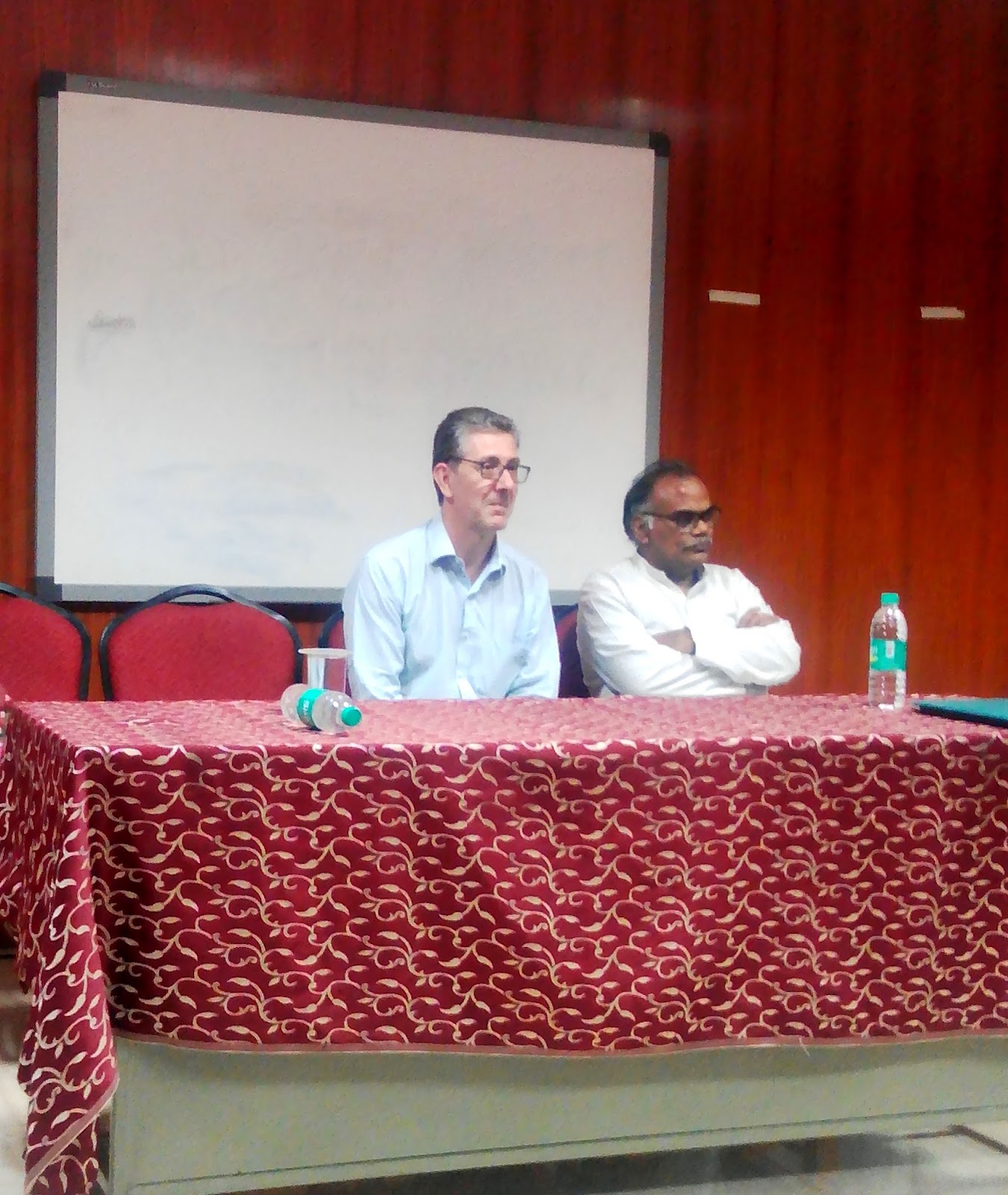
Dr. Tim Cadman with Mr. Reddy at R.B.V.R.R Women's College, Hyderabad


Climate Change and Third World Nations
The COP  21, Paris, 2015 was an insightful experience for Dr. Cadman. He shared with us the major ideas and issues of the conference. On a different note, he also observed that developing nations like India should not repeat the mistakes made by the West during the Industrial Age. India, like Australia is a land of sunshine, thus it could develop a major solar power based commercial venture. In nations like India, the youth  could play a major role in saving the environmental system. They must question every activity of the government and ask for answers from the leaders. The youth of India is the fountainhead of its future progress and success.


Dr. Cadman sharing his ideas


Eco-Feminism
Dr. Cadman has long since been aware of the work done by Indian Eco-feminists, like Vandana Shiva. He believes that Eco-feminism is an incredible lens through which the power relation between man and nature can be understood. It can also help us understand the power equation between developed and developing nations. In the vicious cycle of struggle for power, developed countries always manage to control growing nations and this sort of one way control needs to be changed.


Cli-Fi
Dr. Tim Cadman is not only an academic but also a creative writer. When we asked him about how he managed both, he very happily answered that, "one is work and one is pleasure" 
 and he thoroughly enjoyed doing both. Citing the example of J.R.R. Tolkien, Dr. Cadman meticulously illustrated how it is possible for him to write academic monographs and creative novels as well. He recently made a contribution to the emerging genre of climate fiction.  He has been an ardent follower of writers like Arthur C. Clarke and Isaac Asimov. He loves the way science fiction has the ability to preempt the reality that lies before us.  Dr. Cadman's book is called The Changes, Part One and Two 

Jhilam.C


To know more about Dr. Cadman and his work, visit: https://www.griffith.edu.au/professional-page/tim-cadman

Thursday, 7 April 2016

Those Were The Days, My Friends..

And indeed, we thought they'd never end!

As another academic year draws to a close, we find the members of Quills reminiscing about the time spent with friends and sincerely wishing that the good days didn't have to end so soon. 


Presenting Mahe Mubeen of BBMT III year, with her touching words


RAINY TALES


I sat in my window, watching the falling rain,
all things at peace, nothing in vain.
I let my hair down, feeling the cold soft breeze
listening to it as it whispered through the trees,
Sitting there, I started walking down memory lane-
All those days with my friends in the rain.
Starting with my first day of school in June
How I did whine and cry and mourn.
The next year I got my first friend
With whom I felt worthy and glad
Together in the rain we danced and played 
She stayed with me till the sixth grade
Then she left me forever with a sad goodbye
She was the only one I had by my side.
And again it was like that first day of school in June
Again I did whine and cry and mourn
But, then I made friends and soon we were four
Hanging out together, joyous that ever before
Together in rain we swirled about,
Laughter, fun and happiness abound!
FDAM was the name we named our clan
Gathering happiness along with rain
With all my friends I never felt alone
I never felt Time and how I have grown
Then a friend left and in turn I got six
Joy and happiness all in the mix
My group changed from FDAM to FADAMS
All I got was more fun and freedom
In rainy days I played in every puddle
Life was easy without any unsolved riddle
We wet our self from tip to toe
We knew only merriment, no friend, no foe.
Even in rain we enjoyed our ice creams
Sharing our different and similar dreams
Now I stand here recollecting my days
Of joy, happiness, glory and grace
My cheeks are wet, not from the rain from skies,
but from the memories that shed a tear from my eyes...


Monday, 21 March 2016

An Evening Well Spent: Meeting Rahul Bose, Lamaakan, Hyderabad, 2016

In this post we bring snippets from a talk delivered by Actor and Rugby Champion, Rahul Bose.
QlC member Ms Jhilam Chattaraj attended the event held at Lamaakan, Banjara Hills, Hyderabad on 18 March 2016

Rahul Bose
The Venue
Curious Audience


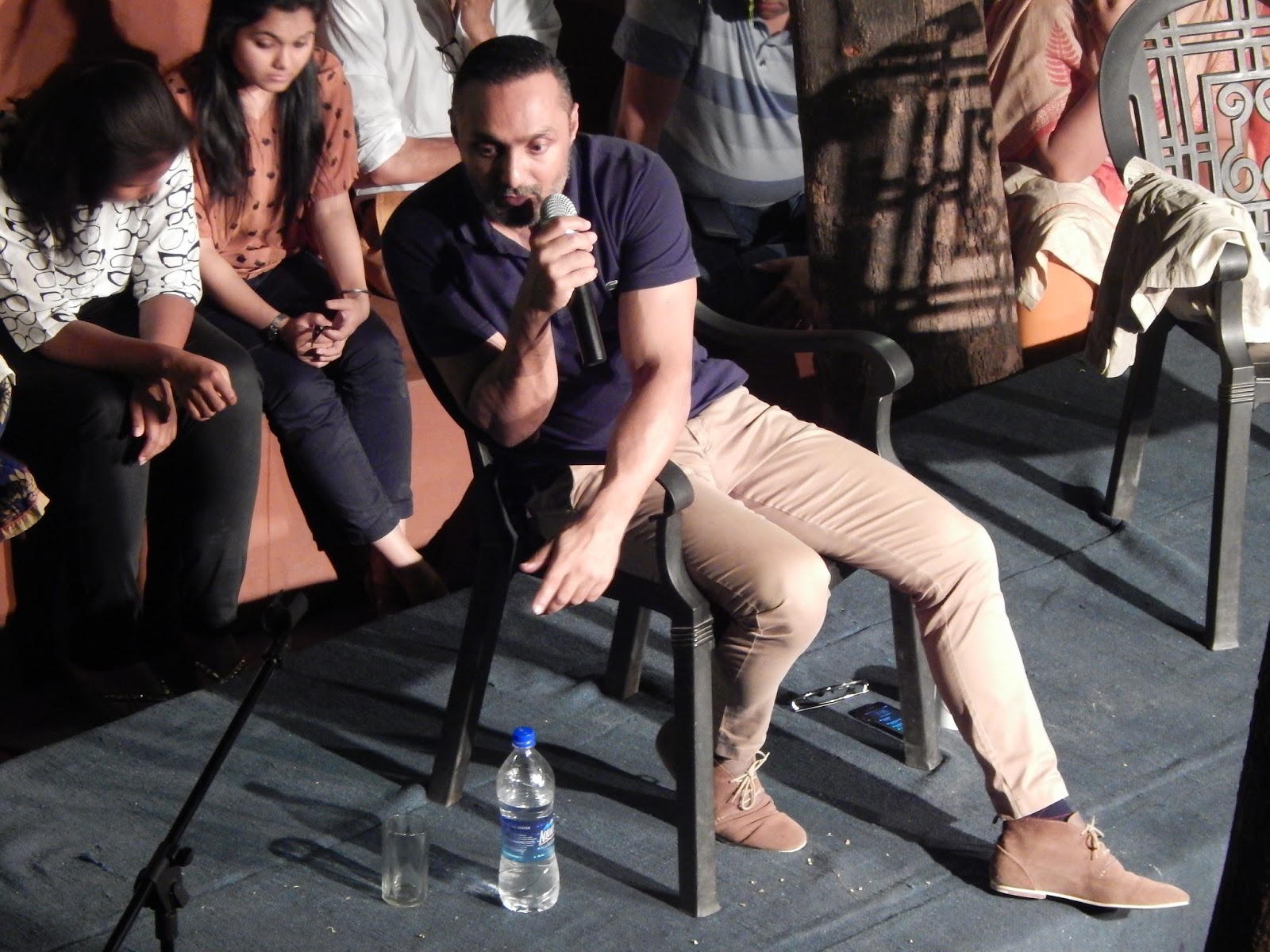
"I don't want to be remembered", said Rahul Bose, the Bollywood actor who delivered a talk on " Workable Leadership Principles". For almost two and a half hours, the charming, intelligent, articulate and incredibly funny actor kept the audience engaged in an evening that was full honest, humorous, insightful, inspiring stories and conversations. 

The venue was packed. There were people all over. The seats were full, the balcony was over crowded, the big boulders were taken, the floor was hardly visible, people sat on the boundary wall and I finally parked myself on a trunk of a tree leaning towards the ground. 
Never underestimate the Balcony


In conversation

Rahul's talk covered several elements. It began with memories of his early days in Bollywood. He recalled the days of struggle and pain and the joy of leading India's Rugby team in various countries. He emphasized on how as a leader of the team he had to under-promise and over-perform to instill a team spirit in everyone. Rahul highlighted the importance of being cordial and empathetic to others as a secret success mantra. Later, on a lighter note, he also revealed little tricks celebrities master over time to deal with rumours , scandals, gossip and criticism. The audience asked him several questions and he answered them with impeccable wit and patience. He sportingly posed for the selfie crazy young girls and boys.   

Elahe Hiptoola, fashion designer and founder of Lamaakan


Rahul's unbelievably self-effacing nature, moderate career aspirations, spartan lifestyle and a genuine concern for the society makes him a very uncanny Bollywood actor. He is a star living out of stardom in a little Innisfree of his own. His joy is in being the ordinary man doing extraordinary things. Thus his talk was about locating the qualities of leadership in our everyday regular lives and not in some grand aspiration to save the world. 

In a world of his own
Rahul encouraged the audience to understand the power of the present and their immense capacity to make a difference in the world just by doing one good thing each day. He has no desire to be quoted or remembered in the annuls of history and culture. He described himself as an ordinary man who loves to play Rugby and act in films with equal passion and give something  back everyday to the society. 
In the initial years, he enjoyed the fame and fanfare. However, looking back, he regrets his once apathetic approach towards many of the social and cultural evils around him.   He now tries to do his bit through his NGO, Rahul Bose- The Foundation which is dedicated to remove any kind of discrimination from all aspects of life. 

The evening with Rahul ended at about 8.30 p.m. I was full of thoughts and emotions. I carry back his confidence, humour, and the courage to live life authentically. 

An actor and a keen listener

Friday, 11 March 2016

A Tailor Made Event: A Report on the Taylor and Francis Journals Editorial Roundtable, 2016 Hyderabad

QLC member, Assistant Professor, Ms Jhilam Chattaraj recently attended the Taylor and Francis Journals Editorial Roundtable, 2016. In this post, she shares her experience. 

Journal titles kept for display

Just Getting Ready!

Introduction


9 March 2016, was indeed an interesting day for me. It was a journey that began in atmospheric darkness and ended in intellectual illumination. I am talking about the early morning solar eclipse and The Taylor and Francis Journals Editorial Roundtable, held at Taj Vivanta, Hyderabad. It was an unique academic exercise. The theme of the event was Indian Authors in the Global Arena.
           It began at 10.30 am with the Registration. The hall was filled with rich aroma of coffee, sumptuous cookies and murmuring voices of participants exchanging pleasantries and visiting cards. At the Registration desk, I met a young lady beaming with confidence and warmth. After collecting  my kit, I straight away headed to the conference room and took my seat at a table in the third row. I always take the third row. It has a beauty of its own. Neither am I too far from the podium nor too close. I can participate as well as be a wallflower.  And on a lighter note, I have noticed that apart from the first and last rows,  photographers concentrate a lot on the third row :)

At 11.15 a.m, the programme began with a Welcome Address by Ms Nitasha Devasar, Managing Director, T&F India.  She greeted the participants and summarised the purpose of the event and what the audience could take back. It was followed by an enlightening talk by Dr. David Green, International Publishing Director, Taylor and Francis. Through several graphs and pie charts, he elaborated the different aspects of publishing in journals. He encouraged  Indian writers  to concentrate more on their visibility, outreach, Impact and public engagement. He acknowledged the fact that academicians around the globe are under tremendous pressure to publish. But as an Editor, he assured that he would never compromise on the quality of writing.
The gift hamper won by a lucky participant

The next talk was delivered by Prof. Ajaya K. Sahoo Faculty, University of Hyderabad and Editor of the journal, South Asia Diaspora. His brief presentation was titled, “Indian Authors in the Global Arena”. He highlighted the recent trends in submission of articles to journals by Indians and rest of the world. He further indicated the possibilities of co-operation between Taylor and Francis and Indian researchers to bring out journals on issues related to Indian culture and traditions. Prof. Sahoo perceived the journals as a way of archiving traditional knowledge systems of the nation; which is very important in times when cultures have become representative of what Zigmut Bauman calls as “liquid modernity”. 

To familiarise the audience with such novel ways of thinking  and writing,  Mr Gerald Dorey, Associate Editorial Director, South Asia presented a talk on “Digital Trends and Developments”. He explained in detail the aspects of Open Access Journal and the different forms of access to journals. His conclusions also pointed out that Indian research in  Social Sciences and Humanities was disappointingly low. This fact created quite a stir. The panel members and the audience for some time debated upon the reasons for such poor research production by Indian authors. Mr Dorey suggested that Indian writers could either collaborate with authors from first world countries or attend workshops that could guide them to publish in major journals. This session was followed by many questions and it thus left no time for the next presentation. We had to break for lunch.
A poster highlighting the use of social media for promoting research

The post lunch session began approximately at  about 2.15 p.m. Ms Anindita Pandey, the Regional Publishing Manager, South Asia spoke on the “Impact and Engagement: Authors, Articles, Social Media and Altmetrics”. She offered useful tips on how authors could use Facebook and Twitter to promote their work. The next and the last talk of the day was delivered by Mr Colin Bulpitt, Publisher , Physical Science on “Peer Review and Publishing Ethics-Introduction and Context”.
In his engaging talk, he drew attention to several peer-review policies, aspects of plagiarism and the intriguing nature of self-plagiarism. He also put forth certain case studies on dispute regarding authorship of articles before the audience asking them for their response.  The Roundtable winded up at  about 3.30 p.m. 
In Conversation: Ms Nitasha Devasar with a Participant

Colin Bulpitt and his presentation


Dr. Sarumathy and Dr. K. Papamma: Representatives from NIRD, Hyderabad

 Takeaways 


It was a useful and fruitful day for me: Thank You Taylor and Francis! I would like to list down a few points that have caught my attention. I intend to discuss about these in detail with interested faculty members and scholars. And They are:
      1. Why are Indian academicians writing and publishing less? Do we shy away from promoting and engaging others with our work?
      2. What could be done ? Can we organise some workshops or seminars where young researchers can be encouraged and initiated into the process of publication?
      3. Publication is not just about scholarly writing. It is about the visibility, discoverability and impact of scholarship.
      4. The process of writing and access to exclusive pieces of information is going to change. Digital culture has changed and will further complicate the way we perceive and approach the publication process.

Acads love to pose too!
Click, type, enter: Mr Robinson Raju, Publishing Editor, Journals

Conclusions
In the context of contemporary “time-space compression” as elucidated by David Harvey, I wonder how young academicians of the nation who want everything to happen “right here and right now" will sustain the culture of knowledge production and distribution. I have a feeling, that we the young and restless have to learn the hard way. We must inculcate the ability to work and rework our writings. If at all we wish to save our words for posterity then we must produce the finest possible versions of our work  no matter how laborious and time-consuming the process may be. I once again recall the words of Dr David Green, and say that Quality and only Quality can survive the storms of time, technology and cultural changes.